

How to Haul Cargo Between Harare and South Africa

AfroFleet Editorial Team
AfroFleet Technologies
The Harare to Johannesburg lane is the busiest trucking route in Zimbabwe and one of the most important legs of the North-South Corridor. Every day hundreds of trucks in Africa's southern region move fuel, fertiliser, machinery, retail stock and fast-moving consumer goods northbound, while tobacco, chrome, granite, horticulture and timber move south. If you are a Load Owner looking to post a load, or a Load Carrier looking to find loads for your trucks, this guide walks through the route, the paperwork, the timing and the pricing realities of the lane.
AfroFleet Technologies runs a corridor-by-corridor freight loadboard for Southern Africa, and the Harare to South Africa corridor is where the platform started. Everything below reflects what we see on live truck loads posted by our community of more than 200 verified Load Owners and Load Carriers.
The route: Harare to Beitbridge to Johannesburg
The standard road route runs south from Harare on the A4 through Chivhu and Masvingo to Beitbridge, then across the Limpopo into South Africa and down the N1 through Musina, Polokwane and Pretoria into Johannesburg. The full trip is roughly 1,100 to 1,150 kilometres depending on the final delivery point in Gauteng.
- Harare to Masvingo: about 290 km on the A4
- Masvingo to Beitbridge: about 290 km
- Beitbridge to Polokwane: about 200 km on the N1
- Polokwane to Johannesburg: about 320 km on the N1
Loads bound for Durban continue on the N3 from Johannesburg, adding roughly 570 km. Loads for Cape Town are a separate proposition at more than 2,000 km from Beitbridge and usually price as a dedicated full truck load rather than a corridor shuttle.

Beitbridge: what to expect at the border
Beitbridge is the only commercial road crossing between Zimbabwe and South Africa, so every truck on this lane passes through it. The Zimbabwean side was rebuilt between 2020 and 2022 with separate freight, bus and light-vehicle terminals, and a truck that arrives with clean paperwork can now clear in a matter of hours instead of the multi-day queues that were once normal. The South African side still bottlenecks at peak periods, especially in the run-up to the December holidays and at month end when retail deliveries spike.
Practical tips from Load Carriers on AfroFleet:
- Pre-clear. Lodge your entries with your clearing agent before the truck leaves Harare or Johannesburg so the release is waiting when the truck arrives.
- Travel mid-week. Tuesday to Thursday arrivals see materially shorter queues than Friday and Monday.
- Keep the driver's documents in one folder: passport, driver's licence, PrDP for South Africa, vehicle registration, cross-border permit and the road manifest.
- Budget for border costs on both sides, including the Zimbabwe road access fee, carbon tax, ZINARA tolls and the South African cross-border road transport permit.
Documents you will need
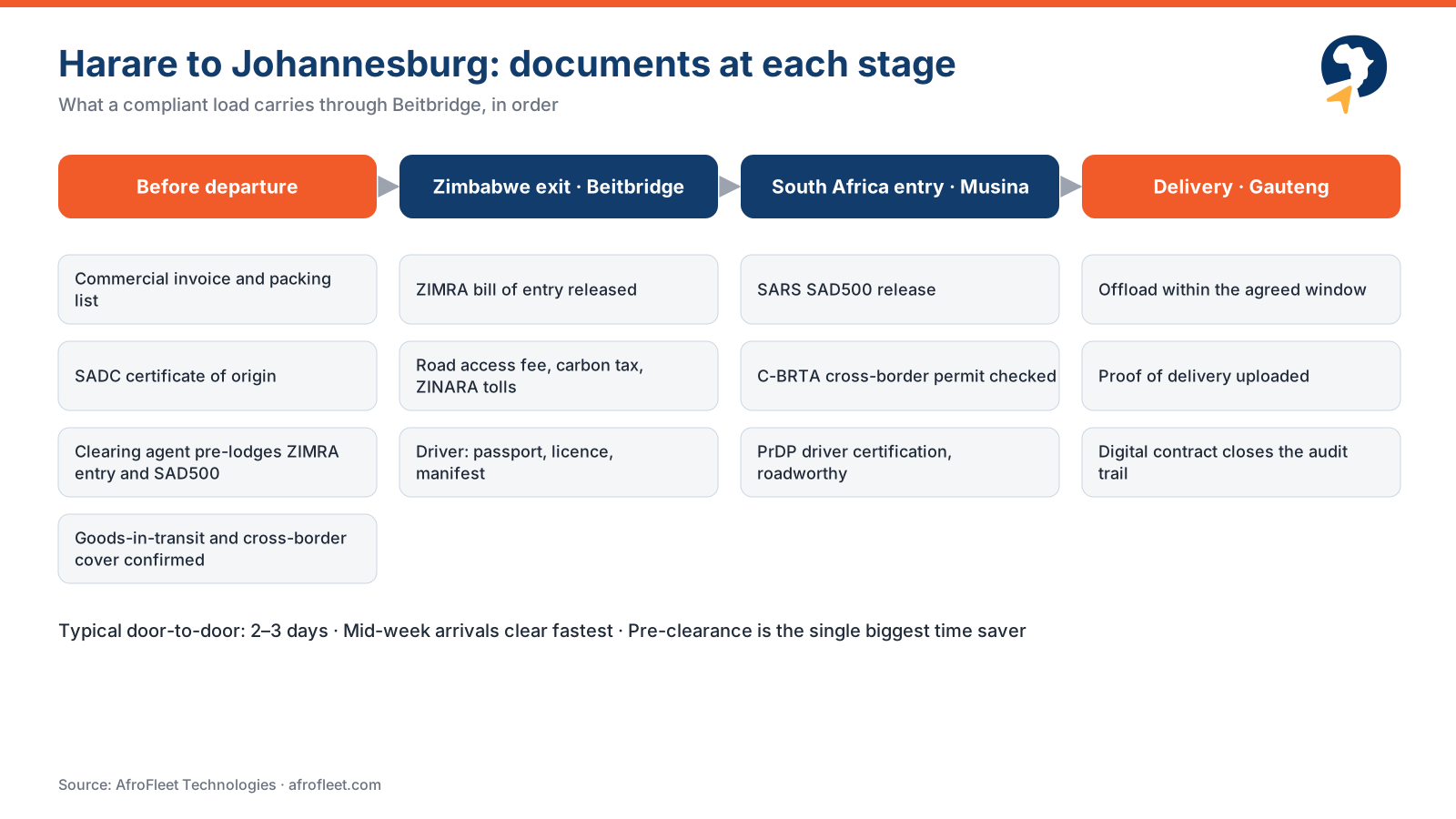
Cross-border freight between Zimbabwe and South Africa is document heavy, and missing paperwork is the single biggest cause of delays. For a typical commercial load you will need:
- Commercial invoice and packing list from the Load Owner
- SADC Certificate of Origin where the goods qualify for preferential duty
- South African customs declaration (SAD500) prepared by a licensed clearing agent
- Zimbabwe Bill of Entry lodged with ZIMRA, with any import or export permits attached
- Road manifest and consignment note for the carrier
- Goods-in-transit insurance certificate covering the declared value
- COMESA Yellow Card or South African third-party motor insurance for the truck
- Cross-border road transport permit issued by C-BRTA for the vehicle
AfroFleet partners with Freight World, a clearing agent that has been in the industry since 1991, so Load Owners who post a load on the platform can have clearance arranged as part of the booking rather than chasing agents at the border.
Transit times and scheduling
A well-run interlink typically completes Harare to Johannesburg in two to three days door to door, including border clearance and legal driving hours. Time-critical loads such as chilled horticulture can be done in under 48 hours with pre-clearance and a two-driver crew. When you post a load on AfroFleet you set a pickup window and a delivery window, and Load Carriers bid against those windows, so be realistic: a tight window attracts fewer bids and a higher price.
What it costs and why prices differ by direction
Rates on this lane are not symmetrical. Zimbabwe imports far more from South Africa than it exports by road, so there are more northbound truck loads than southbound ones. Load Carriers based in Zimbabwe often run south empty to collect a northbound load, and they price that empty leg into the northbound rate. Load Owners moving cargo south from Harare can frequently secure sharper rates because carriers are eager to fill trucks that would otherwise return empty.
The main cost drivers are:
- Fuel, which is the largest single line item and swings with pump prices on both sides of the border
- Tolls, border levies and permit fees
- Driver wages and allowances for two to three days on the road
- Insurance, both goods-in-transit and vehicle cover
- The probability of finding a return load, which is where a loadboard changes the economics
How to find loads and trucks on this lane with AfroFleet
AfroFleet is built to solve the return-leg problem. When a Load Owner posts a load from Harare to Johannesburg, verified Load Carriers on the platform see it instantly on the web app, the iOS and Android mobile app, or through our multilingual chatbot. Load Carriers bid, the Load Owner chooses, and both parties sign a digital contract that records the agreed rate, the pickup and delivery windows and the cargo declaration. That contract becomes the audit trail if anything is lost, damaged or stolen in transit.
For Load Carriers, the platform's backhaul matching surfaces southbound freight loads that fit your truck and your return date, so you are not driving 1,100 km empty. For Load Owners, the bidding model means you are comparing several verified carriers rather than relying on one broker's price.
Every carrier on AfroFleet carries a current verification status. Our annual licence and verification fee keeps each AfroFleet identity, its permits, insurance and compliance documents up to date, which is exactly what you want to see before you hand over a load worth several hundred thousand rand.

Common mistakes to avoid
- Sending a truck without pre-clearance and hoping to sort it out at Beitbridge
- Under-declaring cargo value to save on duty, which voids goods-in-transit cover
- Booking a single-driver truck for a time-critical load and ignoring legal driving hours
- Working with an unverified carrier because the quote was cheapest, then having no recourse when the load is delayed or damaged
- Forgetting the return leg and paying for an empty truck in both directions
Getting started
If you move cargo between Harare and South Africa, AfroFleet Technologies gives you a single place to post a load, find trucks, compare bids from verified Load Carriers and lock the deal in a digital contract. If you run trucks on the lane, the loadboard is where you find loads for both directions. Sign up at afrofleet.com, join our WhatsApp community of more than 1,000 transporters and shippers, or talk to the team on +263 778 079 399.
Move freight with AfroFleet
Load Owners post loads and compare bids from verified Load Carriers. Load Carriers find loads and backhauls corridor by corridor. Every deal is secured with a digital contract.


